From Gut Feeling to Precision: How Quantitative Traders Are Winning in Crypto Markets
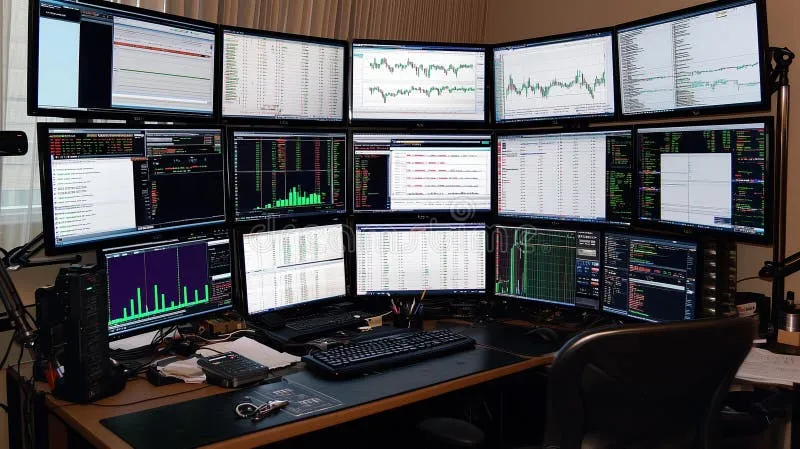
Photo: trader analyzing cryptocurrency data charts on multiple monitors, via thumbs.dreamstime.com
There is a persistent mythology in cryptocurrency circles that successful trading is reserved for those with the sharpest instincts, the fastest reflexes, or the most reliable inside knowledge. The reality, as any consistently profitable trader will confirm, is far less romantic. Winning in digital asset markets over the long term is almost always a product of structure, not spontaneity.
At CoinCasso Group, we spend considerable time analyzing the behavioral and methodological differences between traders who sustain returns across market cycles and those who only perform well when conditions are favorable. What emerges from that analysis is a clear pattern: the traders who endure are the ones who have replaced intuition-driven decisions with repeatable, data-informed frameworks.
The Problem With Emotional Trading
Crypto markets are uniquely susceptible to emotional decision-making. The asset class operates around the clock, across global time zones, with no circuit breakers and minimal institutional guardrails compared to traditional equities. Fear of missing out during parabolic runs and panic selling during sharp corrections are not personality flaws—they are predictable human responses to extreme price volatility.
The consequences, however, are measurable and damaging. A trader who buys Bitcoin at peak euphoria and sells at trough despair does not simply underperform the market—they often destroy capital that a passive holder would have preserved. Studies of retail behavior in both crypto and traditional markets consistently show that timing errors driven by emotion are the single largest drag on individual investor returns.
The antidote is not willpower. It is process.
On-Chain Metrics: Reading the Blockchain as a Data Source
One of the most powerful analytical advantages available to crypto traders—and one that has no direct equivalent in traditional finance—is on-chain data. Every transaction on a public blockchain is permanently recorded and accessible. For traders who know how to interpret this information, the blockchain functions as a transparent ledger of market sentiment, capital flows, and holder behavior.
Several metrics have demonstrated particular utility for timing decisions. The MVRV ratio (Market Value to Realized Value) compares the current market capitalization of an asset against the aggregate cost basis of all holders. When MVRV climbs significantly above historical averages, it suggests that a large proportion of holders are sitting on substantial unrealized gains—a condition historically associated with distribution phases and elevated correction risk. Conversely, deeply negative MVRV readings have repeatedly marked capitulation bottoms in Bitcoin's history.
Exchange inflow and outflow data provides another layer of insight. Large movements of Bitcoin or Ethereum onto centralized exchanges frequently precede selling pressure, as holders typically transfer assets to exchanges in preparation for liquidation. Sustained net outflows from exchanges, by contrast, suggest accumulation and reduced near-term supply.
The Spent Output Profit Ratio (SOPR) tracks whether coins being moved on any given day are being sold at a profit or a loss. During bull markets, SOPR consistently remains above 1.0 as holders take profits. During bear markets, it trends below 1.0 as capitulating investors exit at a loss. Experienced traders use SOPR resets—moments when the ratio dips to exactly 1.0 during an uptrend—as potential re-entry signals.
Volatility Frameworks and Position Sizing
Precision analytics are not limited to market timing. Some of the most impactful applications involve risk management and position sizing—areas where the difference between a 2% loss and a 20% loss can determine whether a portfolio survives a drawdown intact.
The Average True Range (ATR) indicator measures the average magnitude of price movement over a specified period. Professional traders use ATR to calibrate position sizes relative to current volatility conditions. In a high-volatility environment, a trader might reduce position size to maintain consistent dollar risk per trade. In calmer conditions, the same risk tolerance might justify a larger position. This approach—often called volatility-adjusted position sizing—ensures that a single adverse move does not disproportionately damage the overall portfolio.
Another widely used framework is the Kelly Criterion, a mathematical formula originally developed for gambling applications that determines the optimal fraction of capital to allocate to a given trade based on estimated win probability and reward-to-risk ratio. While the full Kelly calculation is aggressive for most traders, a fractional Kelly approach (typically 25–50% of the theoretical maximum) provides a disciplined, mathematically grounded basis for sizing decisions.
Building Systems That Work Across Market Cycles
Perhaps the most important distinction between professional and amateur traders is the emphasis on systems that perform across varying market conditions rather than strategies optimized for a single environment. A momentum strategy that generates exceptional returns during a bull market may be entirely unsuitable during a prolonged bear phase—and a trader who fails to account for this will eventually face a period that erases prior gains.
The most resilient quantitative frameworks incorporate regime detection—mechanisms that identify whether the market is currently trending, ranging, or in a high-volatility breakdown phase. Moving average relationships, such as the 200-day versus 50-day crossover, provide a simple but effective basis for regime classification. More sophisticated approaches incorporate multiple timeframe analysis, combining weekly trend direction with daily momentum signals to filter trades with greater precision.
Backtesting remains an essential component of any systematic strategy. Before deploying capital, rigorous traders simulate their approach across historical data—including periods of severe stress such as the 2018 bear market, the March 2020 COVID crash, and the 2022 FTX collapse. A strategy that survives backtesting across these periods with acceptable drawdowns is far more likely to be structurally sound than one tuned exclusively to favorable recent conditions.
The Role of Portfolio-Level Analytics
Individual trade decisions exist within the broader context of portfolio construction. At the portfolio level, analytical discipline involves monitoring correlation between holdings, tracking overall drawdown relative to peak value, and maintaining predefined rebalancing triggers.
Crypto assets are notoriously correlated during risk-off environments—when Bitcoin falls sharply, altcoins typically fall further and faster. A portfolio that appears diversified across ten digital assets may actually behave like a concentrated Bitcoin bet during a market-wide correction. Sophisticated portfolio managers account for this dynamic by incorporating non-correlated assets, using stablecoins as a tactical buffer, or employing derivatives to hedge directional exposure during periods of elevated systemic risk.
Tracking maximum drawdown as an ongoing metric—rather than reviewing it only in hindsight—allows traders to enforce pre-committed exit rules before losses become catastrophic. A trader who decides in advance that a 20% portfolio drawdown triggers a risk reduction protocol is far better positioned than one who makes that judgment in real time while watching positions deteriorate.
Precision as a Competitive Advantage
The cryptocurrency market in 2024 is no longer the Wild West of its early years. Institutional participants, sophisticated algorithmic traders, and increasingly mature analytics platforms have raised the competitive baseline considerably. For US-based investors and traders operating in this environment, the adoption of data-driven frameworks is not merely an enhancement—it is a prerequisite for sustainable performance.
The good news is that the tools required to implement precision analytics are more accessible than ever. On-chain data platforms, portfolio tracking software, and backtesting environments are available at price points that were unimaginable a decade ago. The barrier is no longer access to information. It is the discipline to use that information systematically, consistently, and without the interference of emotional impulse.
At CoinCasso Group, we believe that analytical rigor is the foundation upon which durable digital asset portfolios are built. The traders who will thrive through the next cycle—whatever form it takes—are the ones investing in process today.