The Hidden Tax of Scattered Holdings: Calculating What Multi-Exchange Fragmentation Is Really Costing You

Photo: cryptocurrency portfolio management multiple exchange screens financial analysis, via as2.ftcdn.net
There is a widely held belief among retail crypto investors that distributing holdings across multiple exchanges is inherently conservative. The logic appears sound on the surface: no single point of failure, no overexposure to one platform's counterparty risk. But precision analysis tells a more complicated story. For many US-based investors, the decision to fragment their portfolios has quietly become one of the most expensive habits in their trading practice — not because of dramatic exchange collapses, but because of a steady, largely invisible drain on returns.
At CoinCasso Group, we routinely examine the structural inefficiencies embedded in how investors hold and move digital assets. What follows is a rigorous breakdown of where fragmentation costs accumulate, how to calculate your personal exposure, and what a more consolidated strategy might look like in practice.
The Spread Problem Nobody Talks About
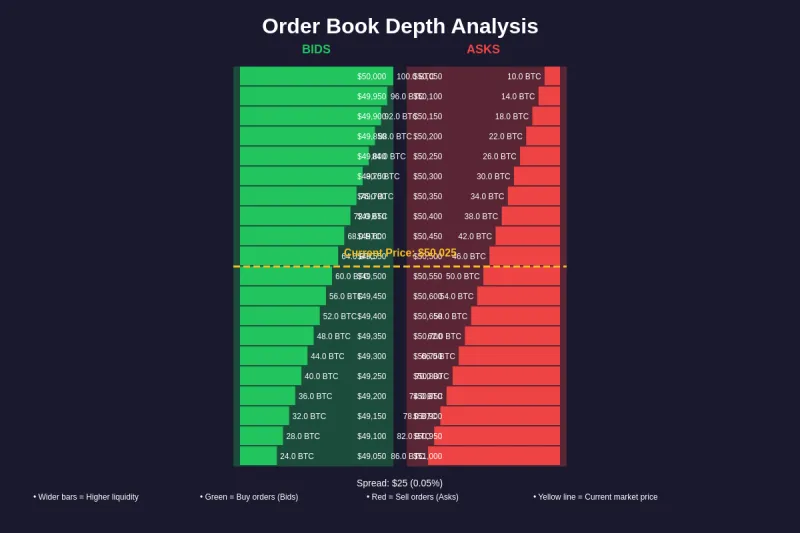
Every exchange operates its own order book, and every order book carries its own bid-ask spread. When Bitcoin trades on Exchange A with a $12 spread and on Exchange B with a $28 spread, the investor who holds positions on both platforms is not simply paying different fees — they are transacting in fundamentally different liquidity environments.
For an investor who executes trades across four or five platforms, the cumulative spread differential over a quarter can be substantial. Consider a hypothetical US investor managing $150,000 in crypto assets distributed across five exchanges. If three of those platforms carry above-average spreads on mid-cap altcoins — a common scenario given that liquidity concentrates unevenly across the market — and that investor executes an average of 20 trades per month, the spread premium alone can represent a drag of 0.4% to 0.9% on total portfolio value annually. That range may sound modest, but compounded over time and measured against the alpha investors are actually generating, it becomes a meaningful detractor.
The calculation becomes sharper when you account for slippage. Fragmented positions are typically smaller per exchange, which means the investor rarely achieves the position size necessary to access institutional-tier liquidity tiers. Smaller orders, even on major platforms, tend to fill at less favorable prices during volatile sessions.
Custody Risk Is Not Evenly Distributed
The collapse of FTX in late 2022 recalibrated how many US investors think about exchange custody risk. Yet the response — spreading assets more widely — may have created a different kind of vulnerability. Holding assets on six exchanges does not simply divide your risk by six. It multiplies the number of custody relationships you are maintaining, each with its own insurance coverage gaps, withdrawal limits, and operational security posture.
Not all exchanges serving US customers carry equivalent levels of regulatory oversight or reserve transparency. Some platforms publish proof-of-reserve audits; others do not. Some maintain FDIC-insured USD balances for fiat holdings; others offer no such protection. When an investor fragments their portfolio without systematically auditing the custodial quality of each platform, they may inadvertently be concentrating meaningful exposure on platforms with weaker structural safeguards — even while believing they have diversified.
A practical custody audit should evaluate each exchange on at minimum four dimensions: regulatory standing with relevant US authorities, proof-of-reserve transparency, withdrawal processing reliability, and insurance or bonding arrangements. Investors who complete this exercise often discover that two or three of their current platforms fail to meet a reasonable threshold on at least one dimension.
The Arbitrage You Are Missing
There is an irony embedded in multi-exchange fragmentation: the investors most likely to hold assets across many platforms are also the investors least positioned to capitalize on the price discrepancies those platforms create. Genuine arbitrage — buying Bitcoin at a lower price on one exchange and selling it at a higher price on another — requires rapid capital deployment and minimal friction. Fragmented portfolios, by definition, carry small position sizes on each platform, and the transaction costs of moving capital between exchanges frequently exceed the arbitrage margin available.
More subtly, fragmented investors miss what might be called positional arbitrage: the ability to size into a position aggressively on the platform offering the deepest liquidity and most favorable spread at a given moment. When capital is spread thin, the investor cannot act decisively. This is not a theoretical concern — it is a structural constraint that shows up in execution quality data consistently.
Building a Fragmentation Expense Ratio
To quantify what multi-exchange distribution is actually costing you, consider constructing a personal fragmentation expense ratio. This metric aggregates four cost categories: spread premium above your lowest-cost platform's average spread, estimated slippage from sub-optimal position sizing, custody risk premium based on the audited quality differential between your platforms, and opportunity cost from missed consolidation-enabled trades.
The calculation requires honest record-keeping. Pull your trade history from each platform for the past 90 days. Identify the average spread at execution for each transaction. Compare that spread to the best available spread for the same asset on your most liquid platform at the same time. The difference, summed across all transactions and annualized, is your spread premium. Add a conservative slippage estimate of 0.05% to 0.15% per trade for positions below $10,000 on mid-liquidity assets, and the picture becomes clearer.
For many investors who complete this exercise honestly, the fragmentation expense ratio lands between 0.6% and 1.8% annually — a figure that rivals or exceeds the management fees charged by many traditional investment vehicles.
A Framework for Strategic Consolidation
Consolidation does not mean returning to a single-exchange model. It means applying the same analytical rigor to custody distribution that a professional fund manager applies to asset allocation. A reasonable framework for most US investors involves anchoring the majority of trading activity — ideally 70% to 80% of active capital — on one to two platforms that score highest on liquidity depth, regulatory standing, and spread competitiveness.
Residual positions on secondary platforms should serve a defined purpose: either capturing a specific asset available only on that platform, maintaining access to a particular derivatives product, or holding a small allocation as a hedge against the primary platform's operational risk. Every secondary exchange relationship should be able to justify itself against the measurable cost it imposes.
Reviewing this distribution quarterly — not annually — ensures that the analysis remains responsive to the evolving competitive landscape among US-compliant exchanges.
Conclusion
The fragmentation trap is not a dramatic failure. It is a slow, structural drag that compounds quietly beneath the surface of a portfolio's performance. For US investors serious about precision in their digital asset strategy, auditing the true cost of multi-exchange distribution is not optional — it is foundational. The numbers, when calculated honestly, rarely support the assumption that broader fragmentation means better outcomes.